
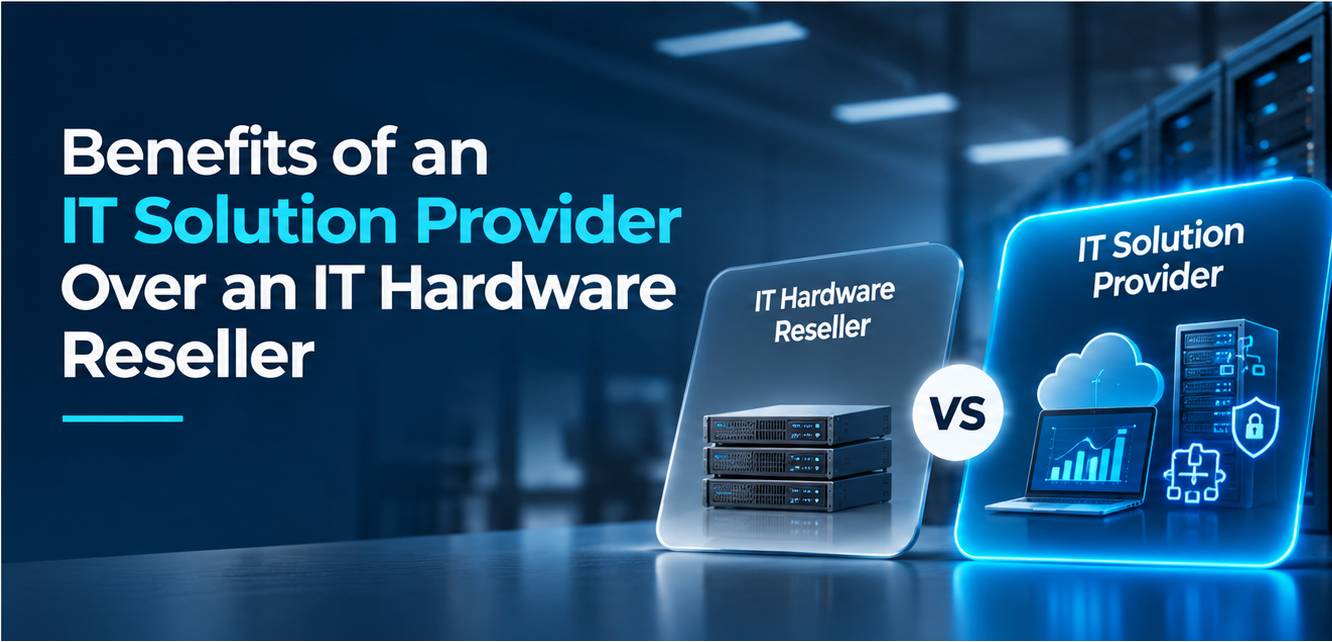
Benefits of an IT Solution Provider Over an IT Hardware Reseller
Choosing the right technology partner is an important decision for businesses looking to build reliable and scalable IT infrastructure. While hardware resellers help organisations procure servers, networking equipment, storage devices, and other IT products, an IT solution provider offers a broader range of capabilities, from understanding business requirements to designing, implementing, and supporting technology environments.
For enterprises managing complex IT operations, the difference goes beyond purchasing equipment. It is about having the right infrastructure, ensuring that different systems work together, and maintaining performance as business requirements evolve.
What Is an IT Solution Provider?
An IT solution provider is a technology partner that helps businesses identify, design, implement, and manage IT solutions based on their operational requirements. Its role goes beyond supplying hardware or software. It involves understanding existing infrastructure, identifying technology gaps, and recommending solutions that address specific business challenges.
Typical IT solution provider services include infrastructure consulting, server and storage deployment, network design, cloud integration, cybersecurity implementation, system integration, and ongoing technical support.
Unlike a transaction-focused reseller, an IT solution provider can remain involved throughout the infrastructure lifecycle, from initial assessment to deployment and maintenance.
IT Solution Provider vs IT Hardware Reseller
Although both businesses operate within the IT ecosystem, their responsibilities and engagement models are different.
| Area | IT Solution Provider | IT Hardware Reseller |
|---|---|---|
| Primary role | Addresses broader business and technology requirements | Supplies IT hardware and equipment |
| Consultation | Assesses infrastructure and business needs | Helps select suitable products |
| Solution design | Plans integrated IT environments | Generally focuses on product specifications |
| Implementation | Can manage deployment, configuration, and integration | May offer product installation, depending on the reseller |
| Ongoing support | Can provide monitoring, maintenance, and optimisation | Support may be limited to product-related assistance |
| Long-term engagement | Can support infrastructure throughout its lifecycle | Often centred on procurement and product transactions |
A hardware reseller can be valuable when a business needs specific equipment or wants to compare product options. However, organisations requiring infrastructure planning, integration, and ongoing management may benefit from working with an IT solution provider.
Key Benefits of Choosing an IT Solution Provider
1. Infrastructure Designed Around Business Requirements
An effective IT environment should support the organisation’s applications, users, workloads, and future plans. An IT solution provider begins by assessing existing infrastructure, identifying performance gaps, and understanding operational requirements before recommending technology.
This helps businesses avoid purchasing equipment that may not integrate properly or meet their actual requirements.
2. Integrated Infrastructure and Technology Deployment
Enterprise environments often involve multiple components, including servers, storage systems, networks, cloud platforms, and security solutions. These systems must work together to support business operations.
An IT solution provider can coordinate infrastructure design, deployment, configuration, and integration. This reduces the complexity of managing separate vendors and technology components.
3. Better Infrastructure Scalability
As businesses expand, their infrastructure must accommodate additional users, applications, data, and workloads. Simply purchasing more hardware may not address underlying capacity or architecture limitations.
An IT solution provider evaluates current infrastructure and plans upgrades around expected demand. This helps organisations expand their IT environments while maintaining performance and operational stability.
4. Security and Business Continuity Considerations
Technology investments should account for security, availability, and recovery requirements. An IT solution provider can incorporate network security, access controls, backup systems, and disaster recovery considerations into infrastructure planning.
This approach helps businesses address potential risks while building more resilient IT environments.
5. Ongoing Support and Infrastructure Management
IT infrastructure requires regular monitoring, maintenance, updates, and performance assessments. Without proper management, even well-designed systems can develop performance issues or become difficult to maintain.
Working with an IT solution provider gives businesses access to ongoing technical support and infrastructure optimisation, helping IT teams maintain system reliability over time.
What Does an IT Solution Provider Do for Enterprises?
The scope of an IT solution provider can vary depending on its expertise and service portfolio. For enterprise infrastructure projects, the engagement typically involves four stages:
- Assessment and consulting: Reviewing existing infrastructure, identifying gaps, and understanding business requirements.
- Design and architecture: Planning server, storage, network, cloud, and security configurations.
- Implementation and integration: Deploying infrastructure components and connecting them with existing systems.
- Ongoing support: Monitoring performance, carrying out preventive maintenance, and planning infrastructure improvements.
This structured approach helps ensure that technology investments are aligned with operational requirements rather than treated as isolated hardware purchases.
How to Choose the Right IT Solution Provider
Before selecting a technology partner, businesses should evaluate more than product availability and pricing. Consider the following:
- Technical expertise: Check experience with enterprise servers, storage, networking, cloud infrastructure, and security.
- End-to-end capabilities: Assess whether the provider can support consulting, design, implementation, and ongoing maintenance.
- Integration experience: Ensure the provider can work with existing infrastructure and applications.
- Security approach: Understand how security and compliance requirements are incorporated into infrastructure projects.
- Support capabilities: Review the provider’s approach to monitoring, maintenance, troubleshooting, and lifecycle management.
The right partner should understand the organisation’s technology environment and recommend solutions based on practical business requirements.
Conclusion
An IT hardware reseller primarily supports equipment procurement, while an IT solution provider can address broader infrastructure requirements through consulting, design, implementation, integration, and ongoing support. For enterprises managing complex IT environments, this broader engagement can simplify technology management and support long-term infrastructure reliability. The right choice ultimately depends on whether the business needs individual products or a technology partner capable of supporting its wider IT objectives.
Frequently Asked Questions
1. Can an IT solution provider work with a business’s existing hardware and infrastructure?
Yes. An IT solution provider can assess existing systems, identify areas that need improvement, and integrate new technologies without necessarily replacing the entire infrastructure.
2. When should a business consider hiring an IT solution provider?
Businesses should consider one when managing multiple IT vendors becomes difficult, infrastructure needs to scale, systems require integration, or internal IT teams need additional technical expertise.
3. Does working with an IT solution provider require a long-term contract?
Not necessarily. Engagement models vary depending on the provider and business requirements. Some projects involve one-time implementation, while others include ongoing support, maintenance, and infrastructure management agreements.
4. What should businesses evaluate before signing an agreement with an IT solution provider?
Businesses should review the scope of services, implementation responsibilities, support availability, escalation procedures, service-level agreements (SLAs), and pricing structure before entering an agreement.
Looking for an IT partner beyond hardware procurement? Connect with Vintech today.