How to Choose a Cybersecurity Company in Pune: 8 Factors Businesses Should Evaluate
For businesses in Pune, cybersecurity is closely connected to business continuity. Organisations across IT, manufacturing, R&D, GCCs, and other sectors often operate with a mix of on-premises infrastructure, cloud platforms, connected devices, and third-party systems. This makes choosing the right cybersecurity provider an important business decision.
With several cybersecurity companies in Pune offering different services, businesses need to evaluate providers based on more than individual security products. The right provider should be able to understand the organisation’s infrastructure, security requirements, risks, and long-term technology plans.
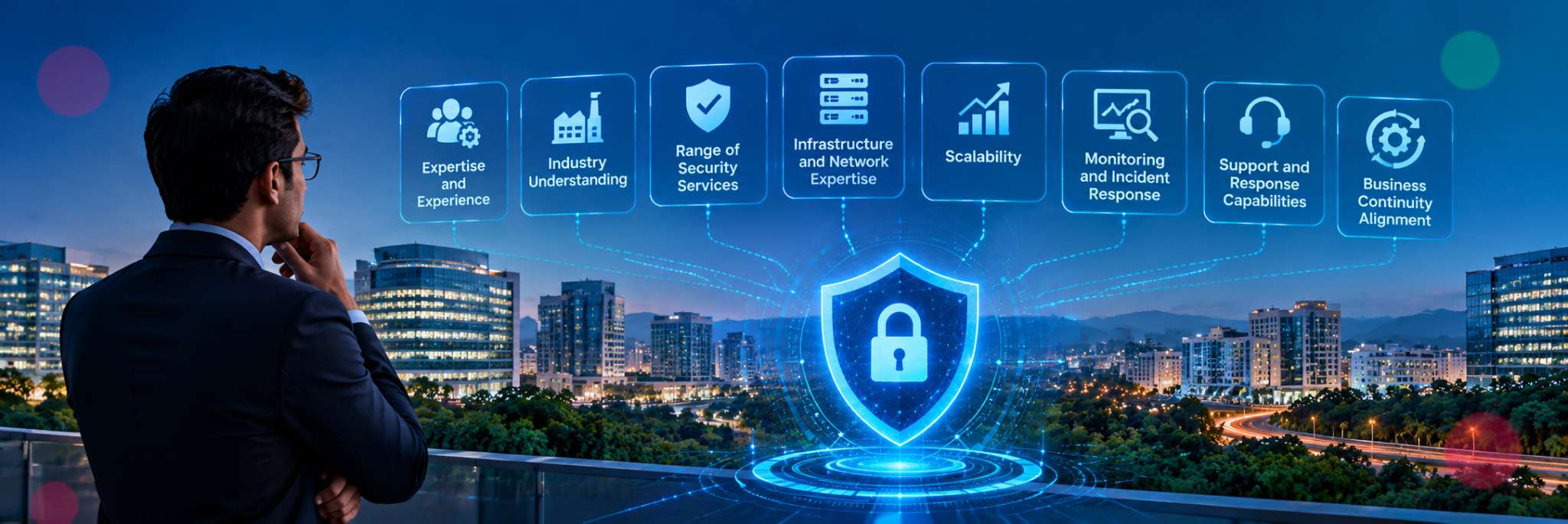
Here are eight factors businesses should consider when selecting a cybersecurity partner.
1. Cybersecurity Expertise and Experience
Start by assessing the provider’s experience with enterprise IT environments. Look for expertise across areas such as network security, endpoint protection, cloud security, vulnerability assessment, identity management, and incident response.
A provider with broader technical capabilities can better understand how different security layers interact within an organisation.
2. Understanding of Your Industry
Security requirements can vary significantly by industry. A manufacturing organisation may need to protect both IT and operational technology, while an IT or R&D organisation may place greater emphasis on applications, intellectual property, cloud infrastructure, and data protection.
Choose a provider that understands the specific risks and operational requirements of your industry.
3. Range of Security Services
Evaluate whether the provider can address your current and future security requirements.
Important capabilities may include:
- Network and firewall security
- Endpoint and cloud security
- Vulnerability assessment and VAPT
- Security monitoring and SIEM
- Incident detection and response
- Data and email security
- Access and identity controls
A broader service portfolio can reduce the need to manage multiple disconnected security providers.
4. Infrastructure and Network Expertise
Cybersecurity cannot be separated from the underlying IT environment. Network architecture, servers, storage, cloud infrastructure, and endpoints all influence an organisation’s security posture.
A cybersecurity partner in Pune with strong IT infrastructure and networking expertise can assess security alongside the systems that support business operations.
5. Scalability
Your security requirements will change as your business grows. New users, applications, locations, cloud workloads, and connected devices can increase the attack surface.
Evaluate whether the provider can scale its security architecture and services as your environment changes without requiring a complete redesign.
6. Monitoring and Incident Response
Preventive security controls are important, but businesses also need to know how a provider responds when something goes wrong.
Ask about monitoring, threat detection, incident response, escalation procedures, and remediation support. Continuous visibility can help organisations identify suspicious activity and respond before an incident causes wider disruption.
7. Support and Response Capabilities
Security incidents can affect business operations quickly. Evaluate the provider’s support model, availability, response processes, and ability to provide remote or on-site assistance.
For businesses operating in Pune, local support can also be useful when an issue requires physical infrastructure assessment or on-site intervention.
8. Alignment With Business Continuity
Cybersecurity should ultimately support business resilience. A security provider should consider how security incidents could affect critical applications, data, infrastructure, and day-to-day operations.
Look for an approach that connects cybersecurity with backup, recovery, infrastructure resilience, access controls, and continuity planning rather than treating security as a standalone function.
How to Compare Cybersecurity Companies in Pune
Before selecting a provider, create a simple evaluation framework based on your business requirements. Compare providers across technical expertise, industry experience, service coverage, infrastructure knowledge, scalability, monitoring, support, and business continuity.
It is also useful to understand your current environment before approaching providers. Document critical applications, infrastructure, cloud workloads, endpoints, sensitive data, and known security gaps.
This allows you to evaluate whether a provider’s capabilities actually match your requirements.
Conclusion
Choosing a cybersecurity provider requires more than comparing services or technology brands. Businesses need a partner that understands their infrastructure, industry risks, security requirements, and continuity objectives.
By evaluating expertise, industry experience, service coverage, infrastructure knowledge, scalability, monitoring, support, and business continuity, organisations can create a more structured approach to selecting a cybersecurity provider.
For businesses looking for a
cybersecurity company in Pune, the right evaluation process can help align security investments with both current risks and future business requirements.
Frequently Asked Questions
1. How do I choose a cybersecurity company in Pune?
Evaluate providers based on cybersecurity expertise, industry experience, service capabilities, infrastructure knowledge, scalability, monitoring, support, and alignment with business continuity requirements.
2. What services should a cybersecurity company provide?
Depending on your requirements, services may include network security, endpoint and cloud security, vulnerability assessment, VAPT, security monitoring, SIEM, incident response, data security, and access management.
3. Why is IT infrastructure expertise important when choosing a cybersecurity partner?
Security controls need to work with the organisation’s existing networks, servers, cloud platforms, endpoints, and applications. Infrastructure expertise helps ensure that security measures are aligned with the wider IT environment.
4. Should businesses choose a local cybersecurity partner in Pune?
Local expertise can be useful when businesses require on-site support, infrastructure assessments, or faster coordination. However, businesses should also evaluate the provider’s technical capabilities, service coverage, and ability to support their specific requirements.
Find the Right Cybersecurity Partner for Your Business