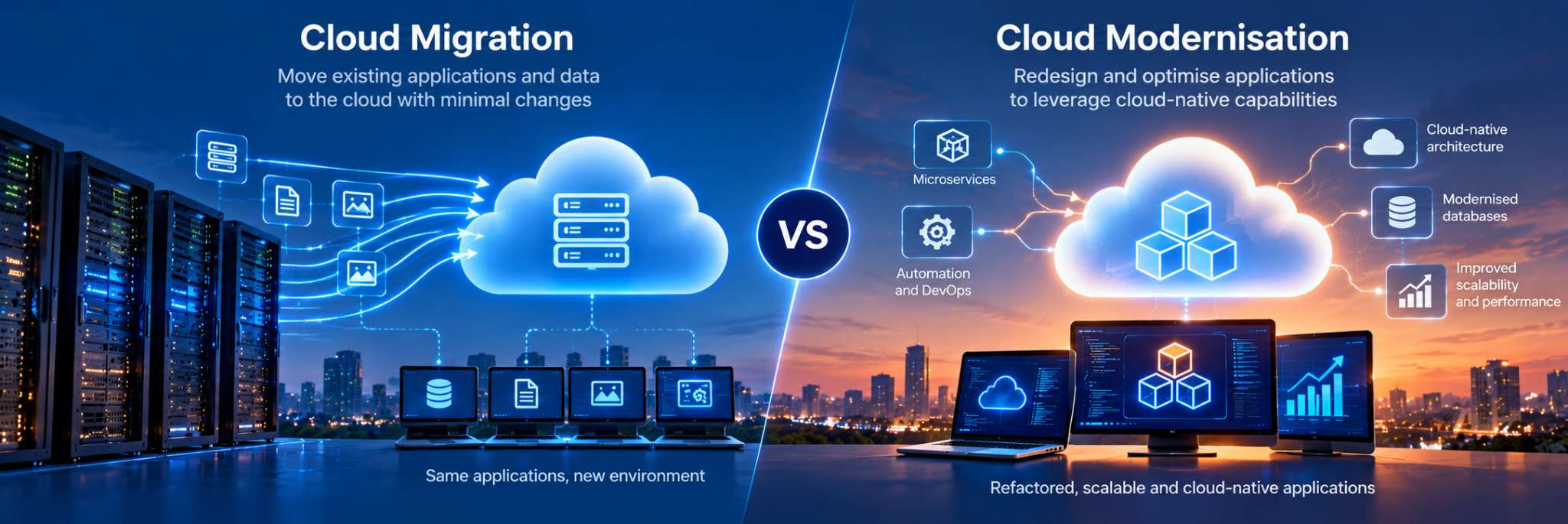
Cloud Migration vs Cloud Modernisation: What Is the Difference and Which Approach Does Your Business Need?
Moving to the cloud is not always about simply transferring existing applications and data from on-premises infrastructure. Some businesses need to move workloads with minimal changes, while others need to redesign applications to take advantage of cloud-native capabilities.
This is where the difference between cloud migration vs cloud modernization becomes important. Although both approaches involve moving toward a modern cloud environment, they address different business and technology requirements.
What Is Cloud Migration?
Cloud migration is the process of moving applications, data, workloads, and IT infrastructure from an existing environment to a cloud platform.
The objective is generally to move workloads securely while maintaining their existing functionality. Depending on the application, businesses may use approaches such as rehosting, replatforming, or refactoring.
Cloud migration can help businesses:
- Move away from ageing infrastructure
- Improve infrastructure scalability
- Support distributed teams and applications
- Reduce dependence on physical data centres
- Introduce cloud-based infrastructure and services
However, migrating an application does not necessarily change how the application itself works.
What Is Cloud Modernisation?
Cloud modernisation goes beyond moving workloads. It involves changing applications, infrastructure, or architecture so they can make better use of modern cloud capabilities.
This may involve:
- Redesigning applications
- Moving to cloud-native architectures
- Using containers or microservices
- Introducing automation and DevOps
- Modernising databases and data platforms
- Improving application scalability and performance
The objective is to make applications better suited to the cloud environment rather than simply relocating existing systems.
Cloud Migration vs Cloud Modernisation: Key Difference
The simplest way to understand the difference is:
Cloud migration moves workloads to the cloud, while cloud modernisation changes workloads to work more effectively in the cloud.
For example, a business may move an existing application from an on-premises server to a cloud virtual machine with minimal changes. This is migration.
If the same business redesigns that application using cloud-native services, containers, automated deployment, and scalable architecture, it is modernisation.
Both approaches can be part of a broader cloud modernization strategy, depending on the organisation’s technology roadmap.
Cloud Migration and Modernisation: When Should You Choose Each?
The right approach depends on the condition of existing applications, business priorities, budget, and desired outcomes.
Choose Cloud Migration When:
- Existing applications are stable and meet business requirements
- The priority is moving away from on-premises infrastructure
- Migration needs to happen within a defined timeframe
- Major application changes could create operational risk
- The organisation wants to establish a cloud foundation first
Consider Cloud Modernisation When:
- Legacy applications limit scalability or performance
- Applications need frequent updates
- Existing architecture is difficult to maintain
- The business wants to use cloud-native capabilities
- Automation and faster application delivery are priorities
In many cases, businesses do not need to choose one approach exclusively.
Can Businesses Combine Cloud Migration and Modernisation?
Yes. A phased approach can combine both.
An organisation may initially migrate a workload to the cloud with limited changes and modernise it later. This can reduce immediate migration complexity while creating a longer-term path toward a more modern application environment.
Other applications may be modernised before migration if their existing architecture would create limitations in the target cloud environment.
This approach allows businesses to prioritise workloads based on business value, technical complexity, security requirements, and cost.
How to Build a Cloud Modernisation Strategy
A practical strategy should begin with an assessment of the existing IT environment.
Businesses should evaluate:
Application readiness: Identify which applications can be migrated directly and which require architectural changes.
Business criticality: Prioritise workloads based on their importance to business operations.
Technical dependencies: Understand application, database, network, and infrastructure dependencies before making changes.
Security and compliance: Determine access, data protection, governance, and regulatory requirements.
Cost considerations: Compare migration and modernisation costs with expected infrastructure and operational requirements.
Future requirements: Consider scalability, automation, analytics, AI, and integration requirements when defining the target architecture.
This assessment helps organisations avoid applying the same approach to every workload.
What Approach Does Your Business Need?
There is no single approach for every enterprise.
If the primary requirement is to move existing workloads to a more scalable infrastructure with limited application changes, cloud migration may be appropriate.
If legacy architecture is restricting business growth or preventing applications from taking advantage of modern cloud capabilities, modernisation may provide a better long-term direction.
For larger environments, a combination of migration and modernisation may be more practical. Critical workloads can be modernised while less complex applications are migrated with minimal changes.
A structured cloud migration and modernization roadmap can help organisations determine which workloads should be migrated, modernised, retained, or eventually replaced.
Conclusion
Understanding
cloud migration vs cloud modernization is important when planning a cloud strategy. Migration focuses primarily on moving workloads to the cloud, while modernisation involves changing applications and architecture to make better use of cloud capabilities.
The right approach depends on the organisation’s existing infrastructure, application landscape, business priorities, security requirements, and long-term technology goals.
Rather than moving every workload using the same method, businesses can assess each application and create a phased roadmap that balances migration speed, modernisation requirements, cost, security, and future scalability.
Frequently Asked Questions
1. What is the difference between cloud migration and cloud modernisation?
Cloud migration involves moving applications, data, or workloads to a cloud environment. Cloud modernisation involves changing applications or architecture to make better use of cloud-native capabilities.
2. Is cloud modernisation part of cloud migration?
It can be. An organisation may migrate a workload first and modernise it later, or modernise an application before moving it to the cloud.
3. Is cloud modernisation more expensive than migration?
Modernisation can require greater investment because it may involve application redesign, development, testing, and architectural changes. The appropriate investment depends on the application’s complexity and business requirements.
4. How should a business decide between migration and modernisation?
Businesses should assess application dependencies, technical limitations, business criticality, security requirements, costs, scalability needs, and long-term technology goals before selecting an approach.
Plan Your Cloud Migration and Modernisation Journey